Gorana Maricic Q&A: Ma Vie en France
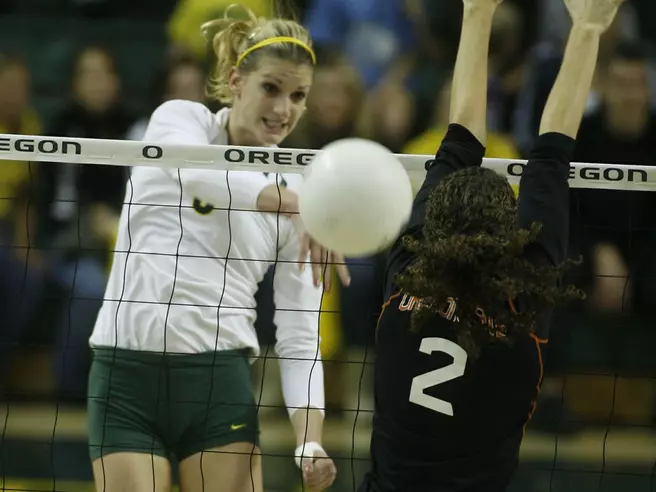
EUGENE - One of the Ducks’ greatest volleyball players, Gorana Maricic, has been busy the first half of this year starting her professional career in France.
The Subotica, Serbia native wrapped up her two-year Duck stint last December ranked third all-time in career points (1217), fifth in career attack percentage (.269) and ninth in career kills (1089) and attempts (2542). Afterwards, she joined the ?La Rochette’ team in Melun, France and played with the team from January through May.
Here’s what the two-time All-American had to say in a recent Q&A about life as a pro player in Europe.
Q: Talk about team you played for, the league, the season, the city it’s in, etc.?
GM: “The team is a member of the first French league PRO AF, and is in a small town, about 45 kilometers (30miles) south of Paris. There are 14 teams in the league, and five teams earn a bid to compete in European Cups, such as the very famous Cup CEV. The first four teams automatically qualify to play, and the fifth team is determined after a playoff (where teams from the fifth to eighth place in the standings play each other for the last bid). The last three teams drop into a lower level league (National 1), and the first three places from National 1 climb into a PRO AF for the next season. The season lasts for about 10 months. Preseason starts the first week of August, and the last match is in May. In any professional league in Europe, teams basically have to qualify to stay in the same league or climb to a higher level. My team earned fifth place, and it was considered a huge success.”
Q: How does the level of play compare to college?
GM: “I definitively have an advantage coming out of the Pac-10 Conference, no doubt one of the toughest in the U.S. The level is somewhat similar; but one of the main differences is that there are so many girls in this league who are very experienced and also play for their national teams. The thing that compares the most to the Pac-10 is that you can’t ever relax when playing other teams, especially when you play on the road. That wasn’t new for me, since I had two seasons of that in Oregon. I came prepared to adjust to a completely new situation volleyball-wise, and handled it pretty well.”
Q: How much time did you get on the court as a starter or reserve?
GM: “After my first week with the team, the coach felt comfortable putting me in as a starter. I did come in as an opposite side hitter initially because the girl I was replacing was playing that role. I played that position for two weeks, but the head coach realized it was better if I played outside hitter, like I did in Oregon, which turned out better for the entire team. At the beginning I have to be honest, it was not going as smoothly as I had hoped, which I knew would happen somewhat. I had to adjust to a totally new system of playing, teammates, gym, coaching style and language. For instance, in defense I was playing in the zone 6, and that was a new thing for me, since I played zone 5 in Oregon. When in front, I used to go behind the block waiting for the tip, but this time I was staying deep. It happened so many times I would automatically go behind the block to wait for the tip, and I was not supposed to, so Coach and the teammates would constantly remind me to stay deep. I looked so funny and confused, but fortunately I got over it.”
Q: How's life off the court in Melun?
GM: “I lived in the cutest little city. Like Eugene, there’s a river, the Seine, going through the town that continues to Paris. I learned quickly how to use buses and trains, as well as where the most delicious bread in the town is, the best restaurant, and where the best deals were. I lived in a small one bedroom apartment; it was a perfect fit for me and was fully furnished. The gym was a 10-minute walk away, and most of my teammates lived very close by.”
GM: “The interesting fact is that life in a small town could be sometimes overwhelming, since when you went to the store or anywhere, people recognized you as a volleyball player and constantly talked to you, asked questions. Everyone knows where we just played at or where we are going to, which could be fun at the beginning but can take its toll eventually, but I never had any bad experiences.”
Q: What's been your average stats like per match?
GM: “Statistics were not very accurate, like they were in the United States, so it didn’t play a big role. The things that were more important were how many points players had in the match, and basically the hitting percentage, so after every match there was an MVP, and it could be from either team. Our team had lots of great players, and every hitter was the match MVP at least once. In my opinion, that was the main reason of our success, we were so balanced.”
Q: How did you adjust to your new teammates on and off the court?
GM: “I was very fortunate to have great teammates! They made it easy for all the adjustments I had to go through. They were all 20-30 years old, and they all had many years of experience. We all got along amazingly well. The atmosphere inside the team was very healthy, which is not always the case in the pro world. Everyone supported each other on the court. We would also hang out a lot and do things together. It made it special being part of the team that went as far as it did, and being able to celebrate the success together.”
Q: How are you adjusting to that area's culture, language and city?
GM: “Even before I got to France, I knew I was arriving into a completely different culture, with a different language and way of life. I was prepared for it, since I had done it before when I came to the States. I knew it was not going to be easy, and there would be different adjustments. However, it was an amazing experience for me - I grew more as person and learned so much. I would not change anything.”
GM: “I know that many people have their own stereotypes of the French - very straight forward, stubborn, refusing to speak English, etc. However, when I had to travel alone without any French language skills, I would be totally fine, and felt free to ask anyone for help, knowing I would get it.”
Q: What’s been the most fun experiences compared to being a collegiate player?
GM: “Being a professional volleyball player definitely gives me a lot of free time. Practices are once or twice a day, no longer than two hours per session. One match per week, and Sundays are always free. A couple of my teammates were attending college, so they didn’t have lots of free time since they had to study and attend classes. I had an advantage by getting my degree and being done with the school. It took me a surprisingly long time to get used to all the free time I was facing. At the beginning I thought I would go nuts, and it was very weird not having homework, tests, and paper dues anymore. However, I did great on how to manage all of my time, so I was never bored.”
GM: “Since I lived very close to Paris, only 25 minutes by a direct train, I could explore the city very often. Every time I would be on my way to Paris, I would get very excited. My teammates and friends told me at the beginning that the excitement would eventually go away, that it would become a normal thing, but it never did - and I’m glad it didn’t. I am fascinated by Paris. If there was a free afternoon, we would at least go to take a walk in the famous Champs d’Elysee to get a coffee at Starbucks, walk through shops, and head back home. Besides the free time I was using for sightseeing and shopping, I was also using it to cook, learn some French, and hang out with friends, and basically learn a different culture. I enjoyed every minute of it.”
GM: “Another thing that was completely different then in college was that after home matches, all the sponsors, supporters, families, coaches and players would get together in a special club room that would have food and drinks waiting for us. It was typical French food - delicious cheese, bread (baguette), sausages, salads with their a little bitter sauce, and fruits, along with champagne, vine (white and red) along with juices. It was almost rude to come in and not to try the food, and not to toast with the sponsors and heads of the club. They were all great people, fun to talk to, so it wasn’t hard to be around them.”
GM: “Also, I have to mention our fans and supporters. They were so great, so into it, cheering loud every point with us, and being there with their heart and soul. We had a band that followed us to almost every match we played away, and it was really nice knowing someone was there for you. They were a huge help, and our seventh player on the court. Perhaps that was the reason why our team won every single match but one at home. Of course, the little boys and girls cheering you on, admiring you, and always asking for a picture and a signature after the match, that always made us feel so special.”
- www.GoDucks.com -