Trio That Defined UO Rise United For First Time Saturday
By Rob Moseley
Editor, GoDucks.com
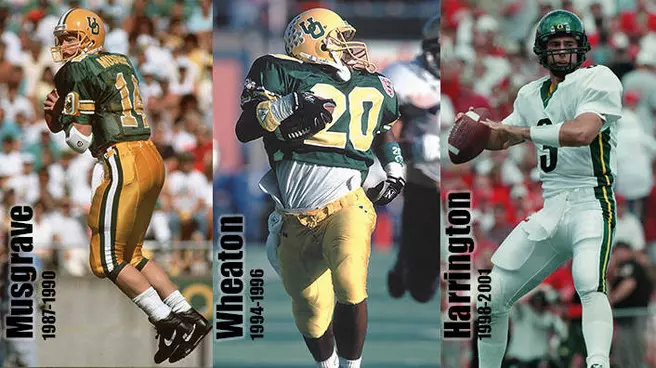
Homecoming is being celebrated at Oregon this weekend, so perhaps it’s appropriate that Saturday’s game against Washington will unite -- for the first time, best anyone can tell -- the three players most closely identified with the Ducks’ rise to national prominence over a 15-year period to close out the last millennium.
Saturday’s honorary captains are the 1989 Independence Bowl team, whose quarterback, Bill Musgrave, led the Ducks to the postseason for the first time in a quarter century. On hand for the 20th anniversary of “The Pick” will be Kenny Wheaton, whose interception against Washington sparked the Ducks’ first Rose Bowl run in nearly four decades. And in the TV booth as a commentator with the Fox Sports 1 crew will be Joey Harrington, who quarterbacked Duck teams from 1999-2001 that made 10-win seasons and national-title contention the expectation around Eugene.
Musgrave arrived on campus in 1986, when the Ducks were coming off their fourth losing season in five years, two seasons after a 6-5 finish in 1984 was a huge deal for the program. Harrington left after 2001, when the Ducks won a then-school record 11 games and, for the first time in the program’s history, had a legitimate place in the national championship race.
When Wheaton picked off his pass against the Huskies in 1994, Oregon had been to nine bowl games in its previous 95 years of existence, and was sub-.500 for its history. In the 20 years since, the Ducks have been to 18 bowl games. Since 2010, nobody in the country has more wins, or a higher winning percentage.
In the 15 years between Musgrave’s arrival and Harrington’s graduation, Oregon went from conference mediocrity to national relevancy. Head coaches Rich Brooks and Mike Bellotti, administrators such as Bill Byrne and Bill Moos, supporters like Phil Knight and Pat Kilkenny all deserve credit for that turnaround. But as far as players go, no three are more closely identified with the Ducks’ meteoric rise than Musgrave, Wheaton and Harrington. And all three will be on hand this weekend.
Musgrave’s redshirt freshman year, 1987, was just the second winning season for the Ducks in the Eighties. By the time he wrapped up his career in 1990, as Oregon’s all-time leading passer with 8,343 yards, the Ducks had made their first two bowl appearances – the 1989 Independence Bowl win over Tulsa, and the 1990 Freedom Bowl – since the 1963 Sun Bowl.
Oregon didn’t have a losing season during Musgrave’s career; for the four-year run without a losing season prior to that, you have to go all the way back to 1954-57. Musgrave, a local columnist wrote, was “the reason, more than any single player, that the Ducks went from losing records to bowl berths.”
Sustained success remained elusive after Musgrave’s departure. The Ducks had losing records in two of the next three seasons, on either side of a return trip to the Independence Bowl in 1992. That all changed with the 1994 season, and “The Pick,” since which Oregon has had just one losing season in 20.
Washington was the No. 9 team in the country when the day dawned on Oct. 22, 1994. Oregon was a measly 4-3, and had just 13 wins over the Huskies in their previous 51 matchups.
The Ducks led 24-20 with just over a minute left, but UW was in the red zone, and a game-winning – make that soul-crushing – touchdown seemed inevitable. That’s when Wheaton, then a redshirt freshman, made a 97-yard run to UO immortality with his interception return that clinched a 31-20 upset.
Oregon upset another highly ranked opponent in Arizona the following week. A 17-13 victory in the Civil War capped a 9-3 regular season, including 7-1 in the Pac-10 to win a conference title. The Ducks went on to the Rose Bowl for the first time since the 1957 season – and none of that would have happened without Wheaton’s interception.
No longer was sustaining success an issue. The 1994 campaign was the first of 10 straight winning seasons. The Ducks played in the Cotton Bowl to cap 1995, and went 6-5 in 1996, the last winning season that didn’t feature a bowl trip.
Still, Oregon’s relevance remained regional. The wins over Washington and Arizona helped vault the Ducks into the top 10 of the coaches’ poll for the final month of the 1994 season. But they hadn’t been top 10 in the Associated Press poll since a single week in 1964.
That changed under Harrington. And it changed for good.
The program was trending upward when Harrington arrived on campus as a redshirt in 1997. The Ducks had won those six games in 1996, and then seven as Harrington set out redshirting. They won eight in 1998, when Harrington made his brief UO debut in Akili Smith’s breakout season. And the Ducks won nine games in 1999, the year in which Harrington took over as Oregon’s starting QB at midseason.
In Harrington’s first full season as the starter, 2000, the Ducks won 10 games for the first time ever, and were ranked in the AP’s top 10 most of the year. When Harrington was a senior, Oregon set another program record for wins with 11, and reached No. 2 in the polls entering the Fiesta Bowl. There they demolished Colorado and bolstered their case for having gotten a raw deal in not making the BCS championship game.
Since 2000, Oregon has been ranked in the top 10 at some point in all but three seasons. It took grit and determination – Harrington’s 25-3 record as a starter included 11 wins when the Ducks were tied or trailed in the fourth quarter – but the Ducks had become a perennial national contender. “The difference between us and everyone else those years,” Harrington said, “(was that) we believed we were going to win the game no matter what happened.”
These days for the Oregon football program, that belief exists every single week. That wasn’t always the case. It became so over a 15-year rise that owes to huge contributions from Musgrave, Wheaton and Harrington, all of whom will be on hand Saturday to watch the Ducks try to extend their run of success against the Huskies.
Quotes from What It Means To Be a Duck and 100 Things Oregon Fans Should Know & Do Before They Die were used as source material.