Recent History Suggested Ducks Would Face Challenges They Now Look To Overcome
By Rob Moseley
Editor, GoDucks.com
After a double-overtime loss to Washington State over the weekend, Oregon heads to Washington on Saturday looking to right its collective ship over the second half of the 2015 regular season.
The Ducks are 3-3 overall, the earliest they’ve had three defeats since 2004. That was also the program’s last losing season, a streak Oregon would very much like to extend for another year.
Pieces are in place on which to establish a turnaround. Running back Royce Freeman is sixth nationally with 143.2 rushing yards per game, after a career-high 246 against the Cougars. The defensive front seven has 20 tackles for loss with 12 sacks over the last two games, with young players such as Henry Mondeaux rising up to complement all-America candidate DeForest Buckner.
But the Ducks will also need improved play in the passing game, on both sides of the ball. Oregon’s quarterbacks are averaging 210 yards per game, 10th in the Pac-12. The secondary is allowing 323.3 yards per game, most in the conference.
Oregon entered this season with senior Vernon Adams Jr. at quarterback, a transfer who boasted the Ducks’ only collegiate starting experience at the position. In the secondary, safety Reggie Daniels was the lone returning starter. Neither played against Washington State this past week, nor did the team’s most experienced returning cornerback, Chris Seisay.
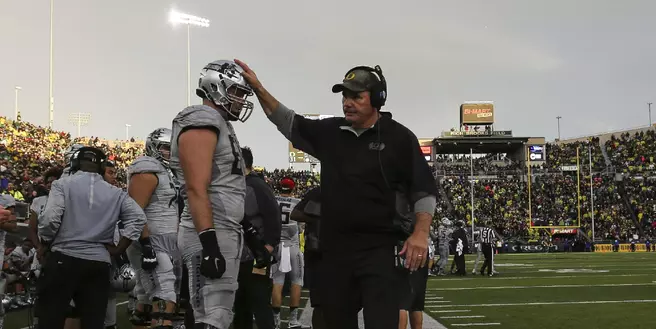
“Great teams have talent, experience and depth,” UO coach Mark Helfrich said Sunday. “You can’t manufacture any of those things. Nobody wants to hear about time, and those are excuses, and that’s totally understandable. And that’s where we have to coach, put them in great position, and then they have to build confidence by what happens – if it’s something not good, we learn from it and flush it, if it’s something good, keep it with you.”
Helfrich said the staff didn’t anticipate inexperience at quarterback and cornerback leading to struggles this season. “We expect whoever is in there to be great, to play great, to prepare great,” he said. “At no point ever do we sit here and say, ‘We don’t have A, B or C, so it’s OK.’ That just doesn’t happen.”
That said, inexperience at quarterback and cornerback has been a marker of Oregon teams from the recent past that experienced struggles.
In the 18 seasons preceding the current campaign, three of the four teams to win seven or fewer games were marked by a similar combination of inexperience at both quarterback and the defensive backfield. Anyone who watched Oregon’s seven-win teams from 1997, 2002 and 2006 might see some similarities with the 2015 squad.
In 1997, Jason Maas and Akili Smith traded time at quarterback, while the secondary adjusted to the loss of starting cornerbacks Kenny Wheaton and LaMont Woods. Five years later in 2002 another cornerback tandem had moved on, Rashad Bauman and Steve Smith, while the offense needed to replace quarterback Joey Harrington. And in 2006, Brady Leaf and Dennis Dixon shared the job of replacing Kellen Clemens at quarterback, while the secondary recovered from the graduation of cornerbacks Aaron Gipson and Justin Phinisee.
Oregon entered 2015 without its Heisman Trophy winning quarterback, Marcus Mariota, and a recent college football trend portended an 8-5 season under that circumstance. The Ducks also needed to replace cornerbacks Ifo Ekpre-Olomu and Troy Hill, along with safety Erick Dargan.
With Adams sidelined for all or parts of four straight games, the Ducks have relied on another quarterback tandem, Jeff Lockie and Taylor Alie. In the secondary, freshmen Glen Ihenacho and Ugo Amadi have played corner along with sophomore Arrion Springs. College football can be unforgiving to inexperience at those positions, as Oregon has been reminded once again.
“There’s a million things we’re not pleased with,” Helfrich said Sunday after reviewing film of the loss to Washington State. “But, now what?”
That’s a question not so easily answered by recent history.
The 1997 team also started 3-3, then found its footing to finish 4-2. That hot streak included wins over rivals Washington and Oregon State, and another in the Las Vegas Bowl. The 2002 and 2006 teams had more helter-skelter experiences; in 2002, Oregon started 6-0 and finished 7-6, and the 2006 team also went 7-6, after a 5-1 start.
As the 2015 team passes the midpoint of its regular season, the Ducks intend to put together a string of consistent performances that result in victory. Their green quarterbacks and young secondary have learned hard lessons over the last month, experiences that – along with the potential return of Adams, Daniels, et al – could serve Oregon well over the stretch run.
“You continue to work and you continue to count on the character of our team, the character of our coaches, the development that’s taking place,” Helfrich said. “That turns into experience, and at some point you’re off and running.”