Ducks Expand Defensive Package To Frustrate California
By Rob Moseley
Editor, GoDucks.com
Ready or not, Oregon’s experiment with simplification had to end.
In the wake of allowing 62 points to Utah in late September, the UO defensive staff streamlined its game plans, primarily for the benefit of a young secondary. The Ducks responded by going 3-1 in October, capitalizing on the simplifications to lead the country in sacks per game during the month, by ending it on a bittersweet note by giving up 742 yards in a triple-overtime win at Arizona State.
Running a tailored package gave the defense a solid base to build upon, but the limited variation was taken advantage of by the Sun Devils. For better or worse, the Ducks knew they needed to expand their package of coverages in order to take on California and NFL prospect Jared Goff on Saturday.
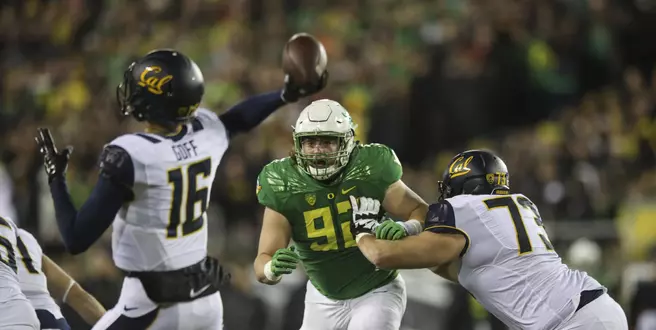
The result: The Golden Bears only mounted one extended touchdown drive, that coming in the fourth quarter after Oregon had a 20-point lead. The Ducks held Goff and his talented receivers in check most of the night, and came away with a 44-28 victory in Autzen Stadium.
“We changed up a few things,” said sophomore cornerback Arrion Springs, who led the UO defense with three pass breakups Saturday night. “We didn’t run the same call as much as did against Arizona State, to get exposed like that. I think that helped a lot.
“We had no choice but to add it in. We couldn’t keep getting exposed like that. We had to continue to grow and keep learning.”
Goff, a potential No. 1 overall draft pick in the spring, finished 18-of-41 for 329 yards and two touchdowns, one of them an 80-yard bomb in the fourth quarter that somehow eluded the grasp of UO safety Reggie Daniels. Oregon led 41-21 at that point, and the Ducks intercepted Goff on his next series to ice the game.
Daniels and Springs started along with safety Charles Nelson and Tyree Robinson. That was the same quartet that started at Arizona State; this was just the second instance all season of Oregon starting the same secondary in consecutive games, the first occurring in the first two games of the year.
Did that consistency give coaches confidence they could expand their scheme this week?
“I would think so – but I also know we had to,” said defensive backs coach John Neal, who coached from the press box for the first time in his UO tenure. “We had to. We’re playing a team that could destroy you if you just kept doing the same things, and obviously last week a little bit of that happened. It was good to change up some things and feel good about having Goff maybe think a little bit more.”
The defense’s senior leader, DeForest Buckner, said it was due time for the Ducks to be entrusted with more responsibility – and for them to prove up to the challenge.
“This part of the season, everybody’s getting better,” Buckner said. “That means our defense has to get better, by adding more stuff, disguising, using more plays. I think guys did a good job picking all that up.”
Of the five Cal scoring drives Saturday, two were set up by blocked UO punts, and two began after Oregon interceptions in the red zone. Both blocked punts set up Cal touchdown drives that began in UO territory.
The Golden Bears converted their first three third-down opportunities while building a 10-0 lead Saturday, taking advantage of what has been an issue for the Ducks all season. But Oregon buckled down, allowing just 3-of-12 third-down conversions from that point on.
The expanded schematic package no doubt helped, and Don Pellum indicated there’s still more the coaches can employ, if players prove capable of executing them.
“For four weeks we kind of did the same things, and I think we established a base,” Pellum said. “At this point it was time to add a little more. And we’d like to add (even) more, but we can’t. We have to be smart with what we’re doing. We have to give our kids a chance to be comfortable and confident and play, and that’s what we did.”