Midseason Change Sparked Volleyball's Surge To NCAAs
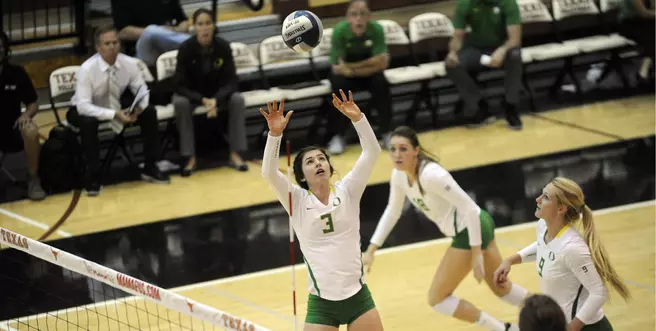
By Rob Moseley
Editor, GoDucks.com
Jim Moore, head coach of the UO volleyball program, is a big-picture thinker with big goals.
When the Ducks were mired near .500 in the middle of the 2015 season, others were pressing him to consider moving from a conventional rotation to the 6-2, which employs two setters. The possibility of moving to a 6-2 prompted several concerns for Moore, not the least of which was one big-picture fact.
“Nobody,” Moore said, “has won a national championship doing it.”
When Moore accepted the advice of his staff and moved to the 6-2, in late October, a national championship was the least of the Ducks’ concerns. Oregon seemed in danger of missing the NCAA Tournament altogether for the first time in five years. The Ducks were 10-9 coming off a loss to USC on Oct. 25, their fourth defeat in five matches.
Oregon’s first match in the 6-2, at Utah, was also a defeat. But the Ducks stuck with it, rallied to finish 6-3 over their remaining matches and on Sunday were announced as an NCAA Tournament team for the fifth straight season.
On Thursday the Ducks open the postseason at Wisconsin. That may never have happened without the move to the 6-2.
“We’re for sure playing a lot better with that,” Moore said. “I can’t completely explain why. But we definitely have been playing better since then.”
Moore also employed the 6-2 a season ago, to take pressure off primary setter Maggie Scott, then a freshman. This fall Scott was ready to handle the job full-time, so the Ducks began the season in a more traditional 5-1 rotation.
By midseason, though, something had to change. The move to the 6-2 was made. In basic terms, it allowed for another blocker to replace Scott when she rotated into the front row, while setter August Raskie took over in the back row for hitter Martenne Bettendorf.
It took time for Oregon’s other hitters to adjust to playing with two different setters. But the Ducks’ defense has improved markedly – opponents are hitting .201 since the switch to the 6-2, Moore said, a drop of about 25 percent.
“I like the transition because I think our blocking has been a lot better,” freshman hitter Lindsey Vander Weide said. “That’s obviously easier for the passers” – a better block makes it easier for back-row players to predict where they need to set up to dig balls and pass them to the setters – “which means better passes, better sets, which turns into better hits for me. Once I got used to both setters, I really like the 6-2.”
The new rotation thrust Raskie into the rotation as a freshman. She was a former prep all-American and top-50 recruit, but it took time to get comfortable competing on the collegiate stage.
“Now that she doesn’t have nerves anymore, she’s playing great,” Bettendorf said. “She used to be nervous even in practice. But now everything’s flowing, and it’s been really good.”
The change was significant for Bettendorf herself, too. A senior and the face of the program entering this season, her inconsistent play out of the back row helped prompt the change.
Bettendorf said the switch at Utah in late October was hard to swallow, but that “I got over it within a couple seconds.” The move seems to have helped her – Bettendorf was hitting .217 prior to the implementation of the 6-2, and has pushed that up to .228 over the last month.
“It’s definitely taken some pressure off me,” she said. “I don’t have to be in there all six rotations. I can just worry about hitting and blocking; I don’t have to worry about the other things. It’s definitely a lot easier for me, and I think it’s a lot easier for Maggie. Overall it just helped the team completely.
“Obviously we turned around the season pretty quickly.”
Oregon’s 6-3 finish may not seem dramatic on the surface. But since losing to Utah in the first match employing the 6-2, the Ducks’ only defeats are to teams currently ranked No. 1, No. 2 and No. 6 in the country.
Thanks to that strong finish, the Ducks and their 16-13 record merited tournament consideration.
“I felt we deserved to get in,” Moore said. “If you’re taking the best teams that are playing the best volleyball at the end, I thought we for sure should get in.”
Still, there were some tense moments Sunday when the tournament field was announced. Then the Ducks saw their matchup with the Badgers, and could celebrate the late-season charge that earned them a spot in the field – thanks in no small part to the change to the 6-2.
“I think we’re playing the best we’ve been all season,” Bettendorf said. “I think if we can continue to keep playing like this, we’re going to go far. We’re going to be a really hard team (to face) in the tournament.”