Graves Keeping Ducks On Track Through Transition
By Rob Moseley
Editor, GoDucks.com
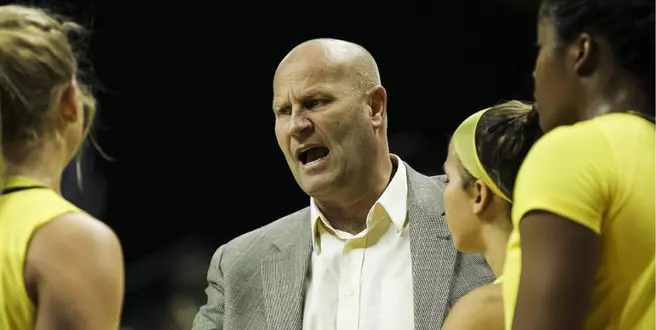
When Kelly Graves took over as UO women’s basketball coach, prior to this season, he put his managers to work with pen and paper during practice. Their task: tracking “loafs” and “selfies” by the Ducks, instances when a player wasn’t working hard enough, or didn’t acknowledge a teammate’s contribution.
At practice Wednesday, the managers would have been busier tracking diving efforts for loose balls, or charges taken. No more do they bother with loafs and selfies. “We don’t have to do that anymore,” Graves said. “They get it.”
On Friday night, the Ducks host Arizona in Matthew Knight Arena at 6 p.m. PT. Oregon has a chance to reach .500 in the final three weeks of the regular season, a remarkable achievement given the dramatically new schemes Graves has installed since being hired. No more are the Ducks run-and-gun; they’re using long possessions to find good shots in the halfcourt, and buckling down on defense.
The last time Oregon (11-12, 4-8 Pac-12) faced the Wildcats, on the road Jan. 25, Arizona won in overtime. It was the sixth straight UO loss, in line with the rebuilding year the Ducks figured to face under Graves. “We definitely kind of hit rock bottom there,” junior Jillian Alleyne said. “Ever since then, a whole new switch has flipped for us.”
The Ducks responded by winning three of four entering Friday’s rematch with Arizona. In the last three weekends of Pac-12 play, Oregon will play all three teams at the bottom of the conference standings, stoking postseason speculation for a team that, just a couple weeks ago, might have folded up the tent and played out the year with an eye toward next season.
“We’re trying things,” Graves said, citing the use of Megan Carpenter to anchor a zone defense, and speedy point guard Drea Toler to spark the team from the opening tip. “It’s not the same every game. We’re juggling things. And I credit the players. They’ve done a nice job of seeing the big picture.”
Oregon won at Washington State a week ago. Later at a team dinner, players were watching their phones for updates from the UW-OSU game, getting an early look at their next opponent – they played in Seattle two nights later – while keeping track of the Pac-12 standings.
When Graves was hired, the Ducks would have been forgiven at least one season taking their lumps, adjusting to a new coach. That hasn’t been the case. “His biggest message is that, we’re good – why are we not competing at our highest level?” said Alleyne, who is leading the way by averaging 17.4 points and 15.5 rebounds per game. “Coach Kelly is such a competitor, that I think it translates over to the team.”
Graves has balanced that competitive drive with a measured approach to recent practices. With Alleyne, Lexi Petersen and Lexi Bando all playing more than 33 minutes per game, the Ducks had two days off to begin this week. When the team scrimmages or holds competitive drills, the loser does things like pushups or jumping jacks rather than wind sprints, to save their legs.
The loss at Arizona helped spark another recent change to practices. That was the sixth straight game in which the Ducks allowed 70 or more points, and so Graves cut down on opponent-specific defensive concepts. In the four games since, Oregon has allowed as many as 70 points just once – the loss at UW.
“We’ve concentrated just on defensive fundamentals – one-on-one, two-on-two, three-on-three,” Graves said. “It doesn’t matter if you scheme; if you still don’t close out correctly, and let somebody drive by you, what does it matter? So that’s when we really started to play better defense.”
Eventually, Graves will get back to one of his passions: game-planning for foes. For now, though, he’s pushing whatever buttons he can to keep the Ducks competitive while also building a new foundation for the program.
It’s been a delicate balance, but one he’s orchestrated beautifully during the stretch run of the regular season. “As long as we’re improving, and we’re continuing to reinforce that, I think they can stay positive and not worry about the results,” Graves said. “But the good thing is, we’re actually seeing results of late.”