Draft Begins Reshaping Of UO Roster
By Rob Moseley
Editor, GoDucks.com
In between a hot start and furious finish to the regular season, Oregon baseball endured a frustrating middle patch to the spring of 2015.
The Ducks’ personality during that stretch of games reared its head again during NCAA Regionals, bringing the season to an end in Springfield, Mo. The program enters the offseason determined to be better next season – a 52-week process that will be shaped in no small part by the events of the next few days.
The Major League Baseball draft begins Monday evening. Rounds three through 10 will be held Tuesday, followed by the final 30 rounds Wednesday, and that’s when the makeup of the 2016 Ducks figures to be most affected. Oregon has several current players and signed recruits on the draft radar.
The coming days, UO coach George Horton said, “will be a very big week for us.”
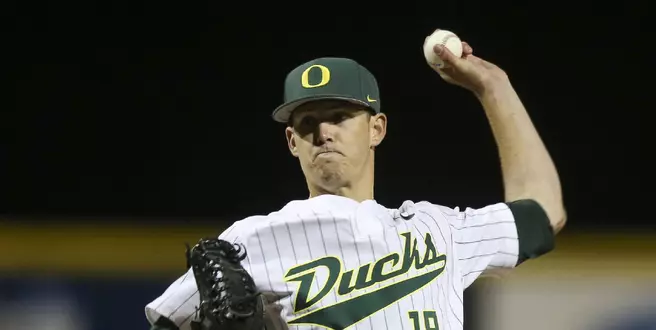
In a postseason brief with reporters last week, Horton seemed resigned to the fact that closer Garrett Cleavinger, pitcher Josh Graham and infielders Mitchell Tolman and Scott Heineman have played their last games at Oregon. Cleavinger and Tolman came into their junior seasons as draft candidates and did nothing to hurt their status; Graham, a former catcher, and Heineman, a utility player who battled injury issues early in his career, took to position changes well and boosted their pro prospects.
Horton is more hopeful that Friday night starter Cole Irvin will be back in Eugene. Though draft-eligible as a third-year player, Irvin was only a sophomore in 2015, after redshirting the year before due to injury. Irvin could return to Oregon and improve his draft stock next spring, while also retaining leverage in negotiations with MLB teams because he would have a year of eligibility remaining for 2017 as well.
“I like the prognosis of having Irvin, (Matt) Krook and (David) Peterson as our starting rotation,” Horton said, envisioning an all-lefty weekend rotation in 2016. “That might be the most special rotation I’ve ever had, if they reach their potential.”
Irvin was 2-5 as a junior with a 4.10 ERA, after going 12-3 with a 2.48 ERA as a freshman in 2013. Krook had a 1.79 ERA with 60 strikeouts in 45 1/3 innings in 2014 before suffering an injury that sidelined him all of last season. Peterson went 4-6 with a 4.39 ERA as a freshman this spring, getting hot down the stretch to help fuel Oregon’s drive to the postseason.
That trio would form an electric rotation for 2016. And the Ducks would have several No. 4 candidates in Conor Harber, Trent Paddon and possibly even Jack Karraker, who sought a medical hardship waiver for 2016 after being injured early in his senior campaign this spring.
Cleavinger doesn’t figure to return at the back of the bullpen. But the Ducks will return step-up man Stephen Nogosek, a future closer who struck out 60 in 58 innings over 39 appearances this season, and had a 2.02 ERA.
On the infield, Mark Karaviotis will be a junior in 2016, after catching fire at the plate over the stretch run in 2015, and shoring up his defense. Also back are Daniel Patzlaff, whose insertion at second base at midseason helped stabilize Oregon’s infield defense, and catcher Tim Susnara.
The corner spots are in flux, with the potential departure of Tolman and Heineman. Brandon Cuddy will be a senior looking to take the next step at first base in 2016, and A.J. Balta will be back after missing the season with a knee injury.
Oregon’s outfield picture is more stable. Starters Phil Craig-St. Louis, Austin Grebeck and Jakob Goldfarb all can return, and all played well down the stretch in 2015. Nick Catalano will be senior, as will Steven Packard, who like Karraker was injured early in his senor spring and requested a medical hardship waiver.
With so many pieces back from 2015, the Ducks will spend the coming months trying to get more production out of them. From hitting to pitching to fielding to baserunning, Horton wasn’t pleased with Oregon’s fundamentals last season.
“We’ll go back and scrutinize every single area,” Horton said. “… We’re still going to play the same style. We just have to do it better.”
Horton said the staff may try to “simplify” some concepts, to free players from overthinking things on the field. He hopes to see a better mental approach in the clubhouse, too, and a team better prepared to handle the adversity a months-long baseball season inevitably presents.
“We went in with high aspirations and high expectations, and liked the culture of these guys; they liked each other,” Horton said. “It was a new team, but it was a team that we evaluated incorrectly, I guess would be the best way you could say it. So we’ll look at every single thing that we can do better.”
The 2015 season featured a jarring end at the hands of Iowa in regionals, after Oregon’s spirited surge into postseason consideration that included three extra-innings wins over ranked teams in the final week of the regular season. Following the loss to Iowa, and over the ensuing days, Horton was left to balance his pride in the late surge with his disappointment in failing to reach Super Regionals – and ultimately the College World Series in Omaha.
Pat Kilkenny, the former UO athletic director who hired Horton when the Ducks reinstated baseball in 2009 and remains a supporter of the program, was on site for Oregon’s disappointing regionals performance. “He’s proud of the young men and proud of us,” Horton said. “And I keep apologizing to him that I can’t get him to Omaha.”
By this time next year, Horton wants to be celebrating a trip to Omaha, rather than apologizing for not getting there. The events of the next few days, and how the MLB draft affects Oregon’s 2016 roster, will have a major impact on that.