Photo by: Rob Moseley/GoDucks.com
02/07/20 | Baseball, @GoDucksMoseley
Oregon baseball opens the 2020 season next week led by a staff packed with program alumni, who have embraced cutting-edge training techniques.
If all goes according to plan for Oregon baseball in 2020 and beyond, the Ducks will look like a classic muscle car, but with a high-tech, modern engine super-charging things under the hood.
The Ducks, who open their season next Friday, Feb. 14, against Minnesota at the Angels College Classic in Tempe, Ariz., are looking to blend the old with the new under first-year head coach Mark Wasikowski. A former UO assistant, Wasikowski has assembled a staff heavy on alumni of the program, the better to achieve his top priority in recruiting — bringing elite players from around the Northwest to Eugene. But it's also a young, forward-thinking group, looking to blend an analytical approach to player development with old-school philosophies between the foul lines.
Among Wasikowski's staff members is former UO pitcher Darrell Hunter, the first recruit to sign with former head coach George Horton when the program was rebooted in 2009. The team's strength coach the past two seasons, Hunter had added video analytics to his duties this year. New to the staff is former UO outfielder Brett Thomas, a 2014 graduate in business who returned to the program after working for Blast Motion, which markets attachable devices that provide advanced swing analysis.
"The tech world is shaping how we teach and coach athletes, and if you don't get on board with that it's passing people up," Wasikowski said. "But yet, we don't want to lose sight of the old-school either. Because there's value in both."

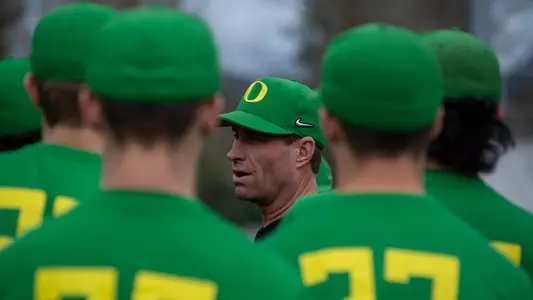
It's up to Wasikowski's two primary assistants, Jack Marder and Jake Angier, to help him balance the two philosophies. Take Marder (above), who played for the Ducks in 2010-11 and was a UO undergraduate assistant while finishing his degree in 2015-16. In the batting cages, Marder is a swing coach, using data collected and analyzed with Thomas to enact individualized development programs for each position player on the roster.
But when the Ducks take the field for practice or a game, Marder evolves from swing coach to hitting coach. Then, his message is about putting together competitive at-bats, without getting lost in the minutiae that was discussed back in the cages.
"When they get into 'compete' mode, are the things that we've been working on actually showing up? That's the goal," Marder said. "When they're emotional and there's pressure and all these things, are we training guys to be able to handle those things and then just go play with their hair on fire? That's when you incorporate the things Coach (Horton) gave us when we were playing here, or the things that 'Waz' brings."
For the Ducks under Wasikowski, a key concept is "mentality." Thomas (below) might be the data cruncher behind the scenes, but he also knows the value of the mentality Wasikowski preaches to his players.

"Mentality just means there's going to be no excuses for getting the job done," Thomas said. "Whether it's an excuse or some inconvenience, you get that out of your mind and say, 'Hey, this is what it's going to look like.' We want to make sure that continues to get saturated with the guys."
Wasikowski, as assistant for some of the most successful seasons in the modern era of UO baseball from 2012-16, is who he is, and that's not going to change. But he's not so stubborn as to ignore other philosophies that might help the Ducks achieve their long-term goal: being a program that travels to Omaha for College World Series appearances.
"He's gonna be old-school, and he'll probably always be that way — hard-nosed," Hunter said. "But he has the ability to take a step back and go, 'OK, maybe there's something I don't know. So, I'm going to hire people that do.'
"I think that's the sign of a good coach. It's not that you can do everything; it's that he can find the people to do things for him and build a program with."

With Wasikowski on staff, Oregon reached the 2012 Super Regionals, and made three more postseason appearances over his remaining four years with the Ducks. When he moved on to become head coach at Purdue, Wasikowski helped the Boilermakers win 39 games and reach the postseason in just his second year, 2018.
So he has reason to trust his approach, which is decidedly old-school.
"On game day, what wins a game? Pitching and defense and timely hitting — and that's never going to change," Wasikowski said. "Now, how are you going to get the pitching and defense and timely hitting to show up on game day? Now you've got modern training techniques."
While Marder is working to improve things like launch angle and exit velocity in the batting cages, Angier (below left) is bringing new-school data analysis into the bullpen as pitching coach. He's pin-pointing with his pitchers the height of their release from the ground, and the distance between their release point and their body. He's perfecting mechanics at a level coaches of the past might have known intuitively but been unable to analyze so precisely.

"We're coaching a generation of kids that are way more process-oriented than when I was growing up, when it was just results-oriented," Angier said. "When the three of us were coming up, we just played sports; we played games. I didn't have a private pitching coach, or a private hitting coach. These kids all grew up with that stuff, so they're constantly focused on the development side of the game, and process."
Because the modern player knows what analytical data is available, he expects to use it to his benefit. Wasikowski has assembled a staff that enables the Ducks to do so.
"When I came to play here and someone asked, 'Why are we doing this,' it was because coach told me to, so I believed in it," Marder said. "Now it's, 'Why are we doing this — and show me that it's right.' And I think it's making us better coaches, because we have to prove it."
Data analysis and the crafting of individualized player development plans only adds to the workload on the modern baseball staff. It can be a grueling grind, but the sight of so many fellow alumni of the program around the office helps Oregon's staff keep pushing.

"I have a different passion here than I'm going to have if I were to go somewhere else," Hunter (above right) said. "You want the program to be at the top. It means a lot to us. So we're going to put in that little bit of extra work."
For Thomas, the chance to do that at his alma mater, and to help enact Wasikowski's blend of old-school baseball with new-school analytics, was enough to entice him away from the corporate side and back to Eugene.
He's still preaching the promise of advanced analytical data in player development. But he's no longer wearing a suit while doing so, nor measuring success in terms of sales.
"Now," Thomas said, "I get to do it for the 'O.' And that's pretty fun."
The Ducks, who open their season next Friday, Feb. 14, against Minnesota at the Angels College Classic in Tempe, Ariz., are looking to blend the old with the new under first-year head coach Mark Wasikowski. A former UO assistant, Wasikowski has assembled a staff heavy on alumni of the program, the better to achieve his top priority in recruiting — bringing elite players from around the Northwest to Eugene. But it's also a young, forward-thinking group, looking to blend an analytical approach to player development with old-school philosophies between the foul lines.
Among Wasikowski's staff members is former UO pitcher Darrell Hunter, the first recruit to sign with former head coach George Horton when the program was rebooted in 2009. The team's strength coach the past two seasons, Hunter had added video analytics to his duties this year. New to the staff is former UO outfielder Brett Thomas, a 2014 graduate in business who returned to the program after working for Blast Motion, which markets attachable devices that provide advanced swing analysis.
"The tech world is shaping how we teach and coach athletes, and if you don't get on board with that it's passing people up," Wasikowski said. "But yet, we don't want to lose sight of the old-school either. Because there's value in both."
It's up to Wasikowski's two primary assistants, Jack Marder and Jake Angier, to help him balance the two philosophies. Take Marder (above), who played for the Ducks in 2010-11 and was a UO undergraduate assistant while finishing his degree in 2015-16. In the batting cages, Marder is a swing coach, using data collected and analyzed with Thomas to enact individualized development programs for each position player on the roster.
But when the Ducks take the field for practice or a game, Marder evolves from swing coach to hitting coach. Then, his message is about putting together competitive at-bats, without getting lost in the minutiae that was discussed back in the cages.
"When they get into 'compete' mode, are the things that we've been working on actually showing up? That's the goal," Marder said. "When they're emotional and there's pressure and all these things, are we training guys to be able to handle those things and then just go play with their hair on fire? That's when you incorporate the things Coach (Horton) gave us when we were playing here, or the things that 'Waz' brings."
For the Ducks under Wasikowski, a key concept is "mentality." Thomas (below) might be the data cruncher behind the scenes, but he also knows the value of the mentality Wasikowski preaches to his players.
"Mentality just means there's going to be no excuses for getting the job done," Thomas said. "Whether it's an excuse or some inconvenience, you get that out of your mind and say, 'Hey, this is what it's going to look like.' We want to make sure that continues to get saturated with the guys."
Wasikowski, as assistant for some of the most successful seasons in the modern era of UO baseball from 2012-16, is who he is, and that's not going to change. But he's not so stubborn as to ignore other philosophies that might help the Ducks achieve their long-term goal: being a program that travels to Omaha for College World Series appearances.
"He's gonna be old-school, and he'll probably always be that way — hard-nosed," Hunter said. "But he has the ability to take a step back and go, 'OK, maybe there's something I don't know. So, I'm going to hire people that do.'
"I think that's the sign of a good coach. It's not that you can do everything; it's that he can find the people to do things for him and build a program with."
With Wasikowski on staff, Oregon reached the 2012 Super Regionals, and made three more postseason appearances over his remaining four years with the Ducks. When he moved on to become head coach at Purdue, Wasikowski helped the Boilermakers win 39 games and reach the postseason in just his second year, 2018.
So he has reason to trust his approach, which is decidedly old-school.
"On game day, what wins a game? Pitching and defense and timely hitting — and that's never going to change," Wasikowski said. "Now, how are you going to get the pitching and defense and timely hitting to show up on game day? Now you've got modern training techniques."
While Marder is working to improve things like launch angle and exit velocity in the batting cages, Angier (below left) is bringing new-school data analysis into the bullpen as pitching coach. He's pin-pointing with his pitchers the height of their release from the ground, and the distance between their release point and their body. He's perfecting mechanics at a level coaches of the past might have known intuitively but been unable to analyze so precisely.
"We're coaching a generation of kids that are way more process-oriented than when I was growing up, when it was just results-oriented," Angier said. "When the three of us were coming up, we just played sports; we played games. I didn't have a private pitching coach, or a private hitting coach. These kids all grew up with that stuff, so they're constantly focused on the development side of the game, and process."
Because the modern player knows what analytical data is available, he expects to use it to his benefit. Wasikowski has assembled a staff that enables the Ducks to do so.
"When I came to play here and someone asked, 'Why are we doing this,' it was because coach told me to, so I believed in it," Marder said. "Now it's, 'Why are we doing this — and show me that it's right.' And I think it's making us better coaches, because we have to prove it."
Data analysis and the crafting of individualized player development plans only adds to the workload on the modern baseball staff. It can be a grueling grind, but the sight of so many fellow alumni of the program around the office helps Oregon's staff keep pushing.
"I have a different passion here than I'm going to have if I were to go somewhere else," Hunter (above right) said. "You want the program to be at the top. It means a lot to us. So we're going to put in that little bit of extra work."
For Thomas, the chance to do that at his alma mater, and to help enact Wasikowski's blend of old-school baseball with new-school analytics, was enough to entice him away from the corporate side and back to Eugene.
He's still preaching the promise of advanced analytical data in player development. But he's no longer wearing a suit while doing so, nor measuring success in terms of sales.
"Now," Thomas said, "I get to do it for the 'O.' And that's pretty fun."


Tuesday, June 02
Tuesday, June 02
Tuesday, June 02
Tuesday, June 02