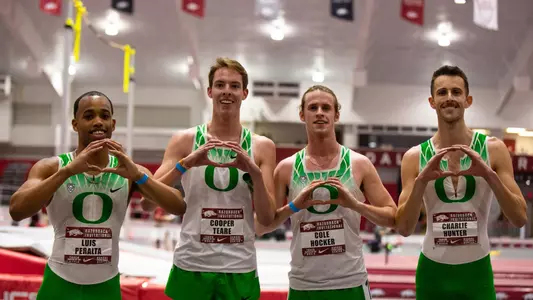
Photo by: Matt Parker
A Run For The Record Books
02/12/21 | Track and Field, @GoDucksMoseley
Looking back on Oregon's world-best time in the distance-medley relay set earlier this season.
Earlier this week, Oregon track and field and cross country head coach Robert Johnson met with media to discuss the Ducks' trip this weekend to the Tyson Invitational in Fayetteville, Ark.
Before previewing that meet, Johnson reflected back to two weeks ago, and the last time Oregon competed on the track. That also was in Fayetteville, and saw the UO men's distance-relay team clock an all-time world best of 9 minutes, 19.42 seconds.
Johnson has been competing and coaching at elite track and field meets for going on three decades now, and that was the third world best he has ever been on hand for. The others were Genzebe Dibaba's 3:50.57 in the 1,500 meters in Monaco in 2015, and Ashton Eaton's unforgettable decathlon performance at the 2012 U.S. Olympic Trials, when he accumulated 9,039 points at Hayward Field.
"Those things just don't come around often, so they should be special," Johnson said.
The world best by the men's distance-relay group in January was made all the more amazing by the fact it was Oregon's first competition since the COVID-19 pandemic began. The first UO runner to step onto a track for an event final at a collegiate meet since the pandemic began was Cole Hocker, for the lead leg of the DMR. Less than 10 minutes later, Cooper Teare crossed the finish line and the Ducks had run faster that any quartet ever to come before them.
Here's how it happened, in the team's own words (some light editing had been done for the sake of clarity and brevity):
The Ducks had been on site for the 2020 NCAA Indoor Championships in Albuquerque when the pandemic brought athletics to a halt. The fall cross country season was delayed until this spring, leaving only intersquad time trials and exhibitions on the competition calendar for the Men of Oregon.
BEN THOMAS, associate head coach: I knew the guys were fit. One of the things we have been allowed to do is train, which is great. So I knew they were fit; I just didn't know they'd be that sharp.
COLE HOCKER, sophomore: I'd be lying if I said I wasn't shocked a little bit. Because of where we were training, the goal time was slower than that. I think we were all just a little not sure where everyone was going to be, fitness-wise.
COOPER TEARE, senior: We didn't necessarily come into this meet with a lot of good, hard speed work, or any super-crazy workouts under our belt. Ben is very adamant on, hey, don't go for time; go and try to win the race. If you win the race, the times will come.
Teare and Charlie Hunter were on the DMR team that had set the existing NCAA record one year earlier, also at the Razorback Invitational. The time they clocked along with James West and Jacob Miller, 9:24.52, broke a record that had stood for 12 years. It occurred to the new foursome that the year-old record could be in reach — although not necessarily broken by more than 5 seconds.
THOMAS: It's been 11 months since I saw these guys compete in uniform. So we were just so happy to get the chance. For me, I was just excited almost as a fan to see them racing again.

CHARLIE HUNTER, redshirt junior: Going in I don't think any of us had the expectations of setting any world record. Just run, be competitive, compete.
LUIS PERALTA, sophomore: The goal was to break the (collegiate) record. But our goal wasn't to break the world record. It was qualifying for nationals, breaking last year's record.
First on the track for Oregon's leadoff leg of 1,200 meters was Hocker, who had qualified for the 2020 NCAA Indoor meet in the 1,500. The first order of business for the Ducks was winning the race, and Thomas was worried about potential challenges from Iowa State and Mississippi.
THOMAS: I knew they had already had a meet; some of them had a couple meets. Maybe they were a little sharper?
TEARE: Cole Hocker is my favorite person to talk about, ever. I think he's severely underrated. He's finally starting to get some recognition, but he's the future of American running. He's insane.
HOCKER: I just went out and felt the race. I felt good through 800, and saw the time was pretty fast. When I see that and I'm still feeling good, it almost propels me to keep moving, keep moving. The last 200 was really fast. It just felt good to be back out there, and I think some of that helped take over.

THOMAS: The first split was probably the most extraordinary split of all. I don't think I've ever witnessed a collegiate DMR with a 2:49 leadoff leg. For Cole Hocker to lay that down, it's a whole 'nother jump in performance, in terms of his middle-distance ability. So I knew right away this was going to be special. From that point on, it was all just about getting the stick around. With no bad exchanges, we knew we'd end up with something very fast.
Hocker handed off to Peralta, who had qualified for 2020 NCAA Indoors in the 800 with a time of 1:48.10, fifth all-time at Oregon. Peralta would run the 400-meter leg on the DMR, two laps around the indoor track.
PERALTA: I was really excited to be on the team. I wanted to run on the DMR last year, but they didn't know how fast I could run; I was only a freshman. So I was really excited to get to run this year.
TEARE: Luis came back with an awesome second leg (clocking 47.29).
PERALTA: To be honest, I didn't know I was going to go that fast. We haven't worked on speed. The fastest we'd gone in practice was like, 29 seconds (per 200-meter lap), so for me to go 47 is really impressive. I'm looking forward to running a fast 800 pretty soon — and running an even faster 400 hopefully in the DMR at nationals.

Next on the track for an 800-meter leg was Hunter. The native of Australia ran the same leg on the record-setting DMR in 2020, clocking in at 1:48.08. This time he would run 1:47.65, after having spent much of the pandemic at home in Australia.
HUNTER: My driving factor was to be back here and part of a team. To be able to race is really cool, but just to be a Duck and to be back in America and training with the guys day in, day out, and to wear that O, that's what means a lot to me. …When I finished my leg, coach kind of called out to me, 'We're 3 seconds in front.' I was like, oh — it's going to be a good one. Because any time Cooper gets the baton, he's going to bring it home.
Teare, whose indoor collegiate best in the 1,500 of 3:55.50 trails only the great Edward Cheserek and Hunter on the UO all-time list, took the baton with the Ducks on record pace. He would clock a leg of 3:54.61 to finish off the record-setting relay.
TEARE: Getting the baton where I did, I felt fully comfortable I could get the job done. Looking at the clock, I remembered we had run 9:24 the year before. We were already way under pace. If I just click off a 4-minute pace, we can break that record. With 500 to go I made a move, and from there it's just being competitive. I heard all the guys on the sideline cheering, telling me to go get it. You can't not run fast in that environment — seeing those guys you train with every day so ecstatic for you, telling you to go get it.

THOMAS: I've had a lot of athletes do well over the year, and win championships and do things I was pretty impressed with. But this is up there. The way these guys stuck with it and kept their edge was special. Really, really special.
TEARE: There's something about winning individual races, but being able to do it with a team, being able to see those guys after and knowing we all did our part and took care of business, it's a feeling you can't match.
HUNTER: Not only do I have competitors on my team, but I also live with them. I think that's what makes us so good. Right now the depth in the middle distance team is extraordinary; you have seven, eight athletes you're training with day in, day out who have the potential to be national champions, and all-time athletes at Oregon. There's a competitiveness but it's all light-hearted, and respectful of everyone. It's a pretty cool environment to be a part of right now, for sure.
TEARE: Knowing we'd smashed the old record, that we'd set before with a team we thought was pretty unstoppable, is just a testament to where we are. And we're just now getting into more of the harder workouts. I think our ceiling is so high.
Before previewing that meet, Johnson reflected back to two weeks ago, and the last time Oregon competed on the track. That also was in Fayetteville, and saw the UO men's distance-relay team clock an all-time world best of 9 minutes, 19.42 seconds.
Johnson has been competing and coaching at elite track and field meets for going on three decades now, and that was the third world best he has ever been on hand for. The others were Genzebe Dibaba's 3:50.57 in the 1,500 meters in Monaco in 2015, and Ashton Eaton's unforgettable decathlon performance at the 2012 U.S. Olympic Trials, when he accumulated 9,039 points at Hayward Field.
"Those things just don't come around often, so they should be special," Johnson said.
The world best by the men's distance-relay group in January was made all the more amazing by the fact it was Oregon's first competition since the COVID-19 pandemic began. The first UO runner to step onto a track for an event final at a collegiate meet since the pandemic began was Cole Hocker, for the lead leg of the DMR. Less than 10 minutes later, Cooper Teare crossed the finish line and the Ducks had run faster that any quartet ever to come before them.
Here's how it happened, in the team's own words (some light editing had been done for the sake of clarity and brevity):
The Ducks had been on site for the 2020 NCAA Indoor Championships in Albuquerque when the pandemic brought athletics to a halt. The fall cross country season was delayed until this spring, leaving only intersquad time trials and exhibitions on the competition calendar for the Men of Oregon.
BEN THOMAS, associate head coach: I knew the guys were fit. One of the things we have been allowed to do is train, which is great. So I knew they were fit; I just didn't know they'd be that sharp.
COLE HOCKER, sophomore: I'd be lying if I said I wasn't shocked a little bit. Because of where we were training, the goal time was slower than that. I think we were all just a little not sure where everyone was going to be, fitness-wise.
COOPER TEARE, senior: We didn't necessarily come into this meet with a lot of good, hard speed work, or any super-crazy workouts under our belt. Ben is very adamant on, hey, don't go for time; go and try to win the race. If you win the race, the times will come.
Teare and Charlie Hunter were on the DMR team that had set the existing NCAA record one year earlier, also at the Razorback Invitational. The time they clocked along with James West and Jacob Miller, 9:24.52, broke a record that had stood for 12 years. It occurred to the new foursome that the year-old record could be in reach — although not necessarily broken by more than 5 seconds.
THOMAS: It's been 11 months since I saw these guys compete in uniform. So we were just so happy to get the chance. For me, I was just excited almost as a fan to see them racing again.
CHARLIE HUNTER, redshirt junior: Going in I don't think any of us had the expectations of setting any world record. Just run, be competitive, compete.
LUIS PERALTA, sophomore: The goal was to break the (collegiate) record. But our goal wasn't to break the world record. It was qualifying for nationals, breaking last year's record.
First on the track for Oregon's leadoff leg of 1,200 meters was Hocker, who had qualified for the 2020 NCAA Indoor meet in the 1,500. The first order of business for the Ducks was winning the race, and Thomas was worried about potential challenges from Iowa State and Mississippi.
THOMAS: I knew they had already had a meet; some of them had a couple meets. Maybe they were a little sharper?
TEARE: Cole Hocker is my favorite person to talk about, ever. I think he's severely underrated. He's finally starting to get some recognition, but he's the future of American running. He's insane.
HOCKER: I just went out and felt the race. I felt good through 800, and saw the time was pretty fast. When I see that and I'm still feeling good, it almost propels me to keep moving, keep moving. The last 200 was really fast. It just felt good to be back out there, and I think some of that helped take over.
THOMAS: The first split was probably the most extraordinary split of all. I don't think I've ever witnessed a collegiate DMR with a 2:49 leadoff leg. For Cole Hocker to lay that down, it's a whole 'nother jump in performance, in terms of his middle-distance ability. So I knew right away this was going to be special. From that point on, it was all just about getting the stick around. With no bad exchanges, we knew we'd end up with something very fast.
Hocker handed off to Peralta, who had qualified for 2020 NCAA Indoors in the 800 with a time of 1:48.10, fifth all-time at Oregon. Peralta would run the 400-meter leg on the DMR, two laps around the indoor track.
PERALTA: I was really excited to be on the team. I wanted to run on the DMR last year, but they didn't know how fast I could run; I was only a freshman. So I was really excited to get to run this year.
TEARE: Luis came back with an awesome second leg (clocking 47.29).
PERALTA: To be honest, I didn't know I was going to go that fast. We haven't worked on speed. The fastest we'd gone in practice was like, 29 seconds (per 200-meter lap), so for me to go 47 is really impressive. I'm looking forward to running a fast 800 pretty soon — and running an even faster 400 hopefully in the DMR at nationals.
Next on the track for an 800-meter leg was Hunter. The native of Australia ran the same leg on the record-setting DMR in 2020, clocking in at 1:48.08. This time he would run 1:47.65, after having spent much of the pandemic at home in Australia.
HUNTER: My driving factor was to be back here and part of a team. To be able to race is really cool, but just to be a Duck and to be back in America and training with the guys day in, day out, and to wear that O, that's what means a lot to me. …When I finished my leg, coach kind of called out to me, 'We're 3 seconds in front.' I was like, oh — it's going to be a good one. Because any time Cooper gets the baton, he's going to bring it home.
Teare, whose indoor collegiate best in the 1,500 of 3:55.50 trails only the great Edward Cheserek and Hunter on the UO all-time list, took the baton with the Ducks on record pace. He would clock a leg of 3:54.61 to finish off the record-setting relay.
TEARE: Getting the baton where I did, I felt fully comfortable I could get the job done. Looking at the clock, I remembered we had run 9:24 the year before. We were already way under pace. If I just click off a 4-minute pace, we can break that record. With 500 to go I made a move, and from there it's just being competitive. I heard all the guys on the sideline cheering, telling me to go get it. You can't not run fast in that environment — seeing those guys you train with every day so ecstatic for you, telling you to go get it.
THOMAS: I've had a lot of athletes do well over the year, and win championships and do things I was pretty impressed with. But this is up there. The way these guys stuck with it and kept their edge was special. Really, really special.
TEARE: There's something about winning individual races, but being able to do it with a team, being able to see those guys after and knowing we all did our part and took care of business, it's a feeling you can't match.
HUNTER: Not only do I have competitors on my team, but I also live with them. I think that's what makes us so good. Right now the depth in the middle distance team is extraordinary; you have seven, eight athletes you're training with day in, day out who have the potential to be national champions, and all-time athletes at Oregon. There's a competitiveness but it's all light-hearted, and respectful of everyone. It's a pretty cool environment to be a part of right now, for sure.
TEARE: Knowing we'd smashed the old record, that we'd set before with a team we thought was pretty unstoppable, is just a testament to where we are. And we're just now getting into more of the harder workouts. I think our ceiling is so high.
Players Mentioned

DIS
/ Track and Field
MD
/ Track and Field
SPR
/ Track and Field
Distance
/ Track and Field
DIS
/ Track and FieldFriday, May 01
Tuesday, April 14
Wednesday, January 14
Tuesday, January 13