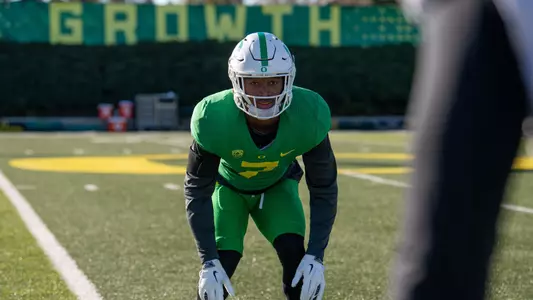
Photo by: Rob Moseley/GoDucks.com
11/23/23 | Football, @GoDucksMoseley
Senior defensive back Steve Stephens IV will play for the final time in Autzen Stadium on Friday, and will leave a legacy off the field as well after completing the final project toward his master's degree.
So often, a legacy can be intangible.
It's the rare player whose legacy lives on in highlights that are replayed over and over on stadium scoreboards. Even less likely, a statue or building sustains one's place in history. More often than not, legacy is constructed out of little more than memory — memories that fade over time, and ultimately are lost.
Steve Stephens IV doesn't have a Kenny Wheaton moment that will be played for all time on the Autzen Stadium scoreboard — not yet anyway, though there's still time. He may not get his name on a facility, as Marcus Mariota does. But future generations of Ducks will benefit from Stephens' time as a UO student-athlete. Which is exactly the kind of legacy he hoped to leave in the first place.
Stephens, a sixth-year defensive back, will play for the final time at Autzen Stadium on Friday, when the UO football team hosts Oregon State at 5:30 p.m. He has spent this fall putting together the most productive season of his career, well on his way to setting new career highs in tackles, and forced turnovers, and passes broken up. And he's also spent it putting the finishing touches on the final project toward his master's degree, a how-to guide for student-athletes navigating the new world of branding and public engagement that he titled, "The Gameplan."
The 55-page guidebook was the "capstone project" for Stephens in the university's advertising and brand responsibility program. But the document won't be one that is relegated to a file folder on a computer, after being handed in for a grade. Stephens' project has the chance to help educate future generations of UO student-athletes who will follow in his footsteps.
"It's comprehensive — it's really like a how-to guide for student-athletes at Oregon," said Katie Harbert, associate athletic director for student-athlete development. "We can say all that stuff as staff and professionals. But if it's coming from their peers, it means something entirely different. So that's why I think there's so much value in it."
"The Gameplan" has chapters on branding, media relations and the unique platform provided by Oregon athletics. Stephens happened to be a student-athlete during a time of tectonic shift in the collegiate landscape. He hopes lessons he learned on the fly about dealing with media and taking advantage of name, image and likeness opportunities will come easier to future Ducks.

"A lot of things I've learned at the back end of my career, I wish I knew on the front end," Stephens said. "I was thinking to myself, all of this makes sense, and as someone who's been around athletics a long time I understand all this. But I can totally see how, for somebody like an incoming freshman, those would all be brand-new concepts.
"I was just trying to think, how can I give back to them what I've learned and been through?"
Stephens' advisor for his final project was Dave Koranda, a professor of practice emeritus and interim director of advertising at the UO School of Journalism and Communication (SOJC).
Stephens wasn't the first student-athlete in Koranda's experience to express an interest in how to capitalize on the notoriety playing a sport provides. What made Stephens different was his interest in helping fellow athletes, including those from sports that don't have the same level of visibility as Oregon football.
"So he's not a typical guy," Koranda said. "And it made it easy to want to help him."
Stephens ultimately hit on the concept of the "invisible athlete;" he surveyed fellow student-athletes to make sure none found that label offensive. The ultimate aim of "The Gameplan" is to empower those "invisible athletes" to employ tools Stephens has learned, leveraging the platform of UO athletics to their benefit.
"We have so many athletes that have a lot of skills and have a lot of great qualities, who might have a huge role on their team but they don't get that much media exposure," Stephens said. "A lot of people don't know who they are, especially if they're not a fan of Oregon athletics. For me personally, it was something that came easy to me. But it doesn't come easy to everyone."

Koranda and others helped Stephens formulate his guidebook. He spoke with Deb Morrison, associate dean for undergraduate affairs at the SOJC, and with former teammate Justin Johnson, who medically retired from football but went on to complete both his bachelor's and master's degrees at Oregon.
The result is a guidebook that not only will help future UO student-athletes; Koranda believes it can be a resource for other athletic departments around the country as well.
As legacies go, that would be something.
"He's just such a phenomenal human being," Harbert said. "He could have done anything, and the fact he chose to do something that's going to leave a mark and leave a legacy here, that just speaks to who he is as a person. It's never about Steve; it's about Oregon, and how can he be a committed, outstanding member of the community here."
Koranda said Stephens hit on the idea of "The Gameplan" for his capstone project early. What exactly it would be comprised of? That took longer to develop.
"There were discussions week after week after week," Koranda said. "We joked about it — he'd say, 'We've been doing this for so long!' We just got used to it."
Of the many lessons Stephens has learned in his career, though, is perseverance. He arrived at Oregon in 2018, and was close friends with two fellow defensive backs in his recruiting class, Jevon Holland and Verone McKinley Jr. Holland is now in his third year with the Miami Dolphins, one of the elite safeties in the NFL. McKinley was a starter for the Ducks as a redshirt freshman in 2019, and is himself now with the Dolphins.
Stephens, on the other hand, didn't become a full-time starter until 2021, a season cut short by injury. He made 10 starts last season, and a career-high 43 tackles. He began this season as a rotation player, entered the starting lineup at midseason and has 40 tackles in 11 games, with the chance to set a new career high as early as his Senior Day this Friday evening.

"It's exciting," Stephens said. "It's a little emotional; it's been a roller coaster up to this point. I've been through a lot, achieved a lot."
He's won conference championships. He's won a Rose Bowl. This year's Oregon team, though, retains even bigger goals as the regular-season finale approaches.
"I want to achieve something I've never done before," Stephens said. "We're in a position to do that. So it means the world to me at this point."
To be sure, Stephens still has time to define his legacy as a player for the Oregon football team, before his career ends after this season. Off the field, though, "The Gameplan" ensures his mark on this university has already been made.
"He's just somebody who stuck with it, always had a good attitude, never wrote himself off," Harbert said. "He's been willing to evolve, willing to keep putting in the work. People like that, you can't help but want to cheer for them. Whatever he does in life, he'll be successful, because of all those same attributes."
It's the rare player whose legacy lives on in highlights that are replayed over and over on stadium scoreboards. Even less likely, a statue or building sustains one's place in history. More often than not, legacy is constructed out of little more than memory — memories that fade over time, and ultimately are lost.
Steve Stephens IV doesn't have a Kenny Wheaton moment that will be played for all time on the Autzen Stadium scoreboard — not yet anyway, though there's still time. He may not get his name on a facility, as Marcus Mariota does. But future generations of Ducks will benefit from Stephens' time as a UO student-athlete. Which is exactly the kind of legacy he hoped to leave in the first place.
Stephens, a sixth-year defensive back, will play for the final time at Autzen Stadium on Friday, when the UO football team hosts Oregon State at 5:30 p.m. He has spent this fall putting together the most productive season of his career, well on his way to setting new career highs in tackles, and forced turnovers, and passes broken up. And he's also spent it putting the finishing touches on the final project toward his master's degree, a how-to guide for student-athletes navigating the new world of branding and public engagement that he titled, "The Gameplan."
The 55-page guidebook was the "capstone project" for Stephens in the university's advertising and brand responsibility program. But the document won't be one that is relegated to a file folder on a computer, after being handed in for a grade. Stephens' project has the chance to help educate future generations of UO student-athletes who will follow in his footsteps.
"It's comprehensive — it's really like a how-to guide for student-athletes at Oregon," said Katie Harbert, associate athletic director for student-athlete development. "We can say all that stuff as staff and professionals. But if it's coming from their peers, it means something entirely different. So that's why I think there's so much value in it."
"The Gameplan" has chapters on branding, media relations and the unique platform provided by Oregon athletics. Stephens happened to be a student-athlete during a time of tectonic shift in the collegiate landscape. He hopes lessons he learned on the fly about dealing with media and taking advantage of name, image and likeness opportunities will come easier to future Ducks.
"A lot of things I've learned at the back end of my career, I wish I knew on the front end," Stephens said. "I was thinking to myself, all of this makes sense, and as someone who's been around athletics a long time I understand all this. But I can totally see how, for somebody like an incoming freshman, those would all be brand-new concepts.
"I was just trying to think, how can I give back to them what I've learned and been through?"
Stephens' advisor for his final project was Dave Koranda, a professor of practice emeritus and interim director of advertising at the UO School of Journalism and Communication (SOJC).
Stephens wasn't the first student-athlete in Koranda's experience to express an interest in how to capitalize on the notoriety playing a sport provides. What made Stephens different was his interest in helping fellow athletes, including those from sports that don't have the same level of visibility as Oregon football.
"So he's not a typical guy," Koranda said. "And it made it easy to want to help him."
Stephens ultimately hit on the concept of the "invisible athlete;" he surveyed fellow student-athletes to make sure none found that label offensive. The ultimate aim of "The Gameplan" is to empower those "invisible athletes" to employ tools Stephens has learned, leveraging the platform of UO athletics to their benefit.
"We have so many athletes that have a lot of skills and have a lot of great qualities, who might have a huge role on their team but they don't get that much media exposure," Stephens said. "A lot of people don't know who they are, especially if they're not a fan of Oregon athletics. For me personally, it was something that came easy to me. But it doesn't come easy to everyone."
Koranda and others helped Stephens formulate his guidebook. He spoke with Deb Morrison, associate dean for undergraduate affairs at the SOJC, and with former teammate Justin Johnson, who medically retired from football but went on to complete both his bachelor's and master's degrees at Oregon.
The result is a guidebook that not only will help future UO student-athletes; Koranda believes it can be a resource for other athletic departments around the country as well.
As legacies go, that would be something.
"He's just such a phenomenal human being," Harbert said. "He could have done anything, and the fact he chose to do something that's going to leave a mark and leave a legacy here, that just speaks to who he is as a person. It's never about Steve; it's about Oregon, and how can he be a committed, outstanding member of the community here."
Koranda said Stephens hit on the idea of "The Gameplan" for his capstone project early. What exactly it would be comprised of? That took longer to develop.
"There were discussions week after week after week," Koranda said. "We joked about it — he'd say, 'We've been doing this for so long!' We just got used to it."
Of the many lessons Stephens has learned in his career, though, is perseverance. He arrived at Oregon in 2018, and was close friends with two fellow defensive backs in his recruiting class, Jevon Holland and Verone McKinley Jr. Holland is now in his third year with the Miami Dolphins, one of the elite safeties in the NFL. McKinley was a starter for the Ducks as a redshirt freshman in 2019, and is himself now with the Dolphins.
Stephens, on the other hand, didn't become a full-time starter until 2021, a season cut short by injury. He made 10 starts last season, and a career-high 43 tackles. He began this season as a rotation player, entered the starting lineup at midseason and has 40 tackles in 11 games, with the chance to set a new career high as early as his Senior Day this Friday evening.
"It's exciting," Stephens said. "It's a little emotional; it's been a roller coaster up to this point. I've been through a lot, achieved a lot."
He's won conference championships. He's won a Rose Bowl. This year's Oregon team, though, retains even bigger goals as the regular-season finale approaches.
"I want to achieve something I've never done before," Stephens said. "We're in a position to do that. So it means the world to me at this point."
To be sure, Stephens still has time to define his legacy as a player for the Oregon football team, before his career ends after this season. Off the field, though, "The Gameplan" ensures his mark on this university has already been made.
"He's just somebody who stuck with it, always had a good attitude, never wrote himself off," Harbert said. "He's been willing to evolve, willing to keep putting in the work. People like that, you can't help but want to cheer for them. Whatever he does in life, he'll be successful, because of all those same attributes."



Players Mentioned

DB
/ FootballWednesday, October 21
Tuesday, October 20
Tuesday, October 20
Tuesday, October 20