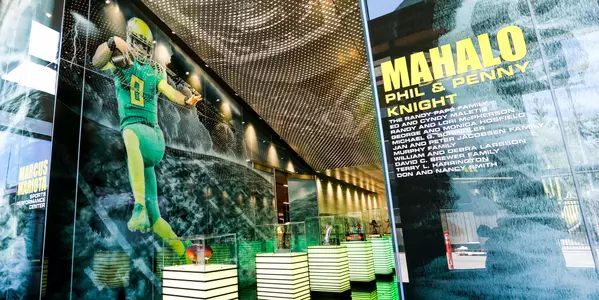
Photo by: Eric Evans/GoDucks.com
How The Mariota Center Helped Dillon Brooks Get Back On His Feet
03/16/17 | Men's Basketball, @GoDucksMoseley
Oregon's new sports performance center opened last fall, and paid immediate dividends for the men's basketball program.
Oregon's revolutionary new Marcus Mariota Sports Performance Center is named for the most decorated football player in UO history.
During its first year of existence, however, its most high-profile success story might be an athlete from another sport — men's basketball. As the Oregon men's team prepares to open the NCAA Tournament on Friday as a No. 3 seed, the Ducks can be thankful for the role the Mariota Center played in helping Dillon Brooks quickly return to form following offseason foot surgery.
Brooks had surgery in July to repair a broken foot. Initial estimates suggested he'd be back around the start of the new year. Instead, he missed just three nonconference games, and was playing at such a high level by the start of conference play that he went on to be named Pac-12 player of the year.
Without the conditioning and confidence Brooks built up in the new sports performance center, there's no telling how his season might have gone.
"The Mariota Center's been a blessing to me," said Brooks, whose Ducks face 14th-seeded Iona in a first-round tournament game in Sacramento on Friday (11 a.m., TBS).
Almost as soon as the performance center opened, foot injuries became a front-burner item for director of performance and sports science Andrew Murray. Several football players suffered foot fractures in recent seasons, and Dylan Ennis missed nearly the entire 2015-16 basketball season with a similar problem.
Shortly after arriving in Eugene, Murray huddled with certified athletic trainers Stephanie Brooks from football and Clay Jamieson from men's basketball to address the issue. Then, Brooks suffered his injury during this past offseason, and the results of those brain-storming sessions could be put to use.
"What can we do with this guy?" Murray recalled asking. "How can we leverage this technology that's now in the performance center to aid his rehab, that potentially hadn't been before?"
Every athlete's recovery includes a "return to play" plan, outlining each progressive step on the road back. Here was a chance to outline new steps, which might shorten that road back to the court for Brooks.
Two pieces of technology ended up playing significant roles in his recovery. The first was an anti-gravity treadmill, which allowed Brooks to do conditioning work while reducing the pressure on his left foot as it continued to heal. He also utilized the Matthew Knight Arena treatment center's underwater treadmill, but the Alter-G anti-gravity unit allows for faster speeds and more precise accounting of how much pressure is being kept off the foot.
Along with conditioning, Brooks' confidence was built up in the Mariota Center. Using force-plate technology, Murray could measure how much force Brooks was generating on his injured left foot as compared with his healthy right foot. As those measurements became more closely aligned, Brooks grew confident in his ability to return to the court.
"When you can see the facts — how much force you're putting into your foot — you can see that, and how much progress you're going through," Brooks said. "It gets your mind off, 'my foot is still hurt,' or, 'I don't feel enough confidence to put that much pressure on it.' …
"When you're not thinking about your hurt foot, or (worrying) if you're hurting it again, you're thinking about getting better and progressing back on the floor."
Thanks to his work in the Mariota Center, Brooks returned for Oregon's fourth game of the season, playing off the bench in a loss to Georgetown in the Maui Jim Maui Invitational. The next day, Brooks' three-pointer in overtime helped the Ducks beat Tennessee at the tournament in Hawaii, the first of what ended up being a school-record 17 straight wins.
Brooks later hit game-winning threes against both UCLA and Cal in conference play, and scored the Ducks' last 12 points in a one-point win over Arizona State. He was named Pac-12 player of the year, and enters the NCAA Tournament averaging a team-high 16.3 points per game.
For Murray and the Mariota Center, Brooks has been an early success story.
"Putting athlete welfare at the forefront of the mindset was obviously the motivation for this building, along with improving performance," Murray said. "… For Dillon, I think he's very fortunate to have this facility so close. The orthopedic surgeon is at the end of the road (up the street from Autzen Stadium); the training site (Matthew Knight Arena) is on the other side of the river, 10 minutes' walk away. It's unique, in terms of the flow for the athlete."
To Brooks, the bottom-line benefits of the Mariota Center were clear.
"My time-table has decreased," he said, " and I got to come back probably earlier than expected."
For an Oregon men's basketball team that had national championship aspirations, and is now in position to play for them in the NCAA Tournament, Brooks' return happened in the nick of time. And thus so too did the opening of the Marcus Mariota Sports Performance Center.
During its first year of existence, however, its most high-profile success story might be an athlete from another sport — men's basketball. As the Oregon men's team prepares to open the NCAA Tournament on Friday as a No. 3 seed, the Ducks can be thankful for the role the Mariota Center played in helping Dillon Brooks quickly return to form following offseason foot surgery.
Brooks had surgery in July to repair a broken foot. Initial estimates suggested he'd be back around the start of the new year. Instead, he missed just three nonconference games, and was playing at such a high level by the start of conference play that he went on to be named Pac-12 player of the year.
Without the conditioning and confidence Brooks built up in the new sports performance center, there's no telling how his season might have gone.
"The Mariota Center's been a blessing to me," said Brooks, whose Ducks face 14th-seeded Iona in a first-round tournament game in Sacramento on Friday (11 a.m., TBS).
Almost as soon as the performance center opened, foot injuries became a front-burner item for director of performance and sports science Andrew Murray. Several football players suffered foot fractures in recent seasons, and Dylan Ennis missed nearly the entire 2015-16 basketball season with a similar problem.
Shortly after arriving in Eugene, Murray huddled with certified athletic trainers Stephanie Brooks from football and Clay Jamieson from men's basketball to address the issue. Then, Brooks suffered his injury during this past offseason, and the results of those brain-storming sessions could be put to use.
"What can we do with this guy?" Murray recalled asking. "How can we leverage this technology that's now in the performance center to aid his rehab, that potentially hadn't been before?"
Every athlete's recovery includes a "return to play" plan, outlining each progressive step on the road back. Here was a chance to outline new steps, which might shorten that road back to the court for Brooks.
Two pieces of technology ended up playing significant roles in his recovery. The first was an anti-gravity treadmill, which allowed Brooks to do conditioning work while reducing the pressure on his left foot as it continued to heal. He also utilized the Matthew Knight Arena treatment center's underwater treadmill, but the Alter-G anti-gravity unit allows for faster speeds and more precise accounting of how much pressure is being kept off the foot.
Along with conditioning, Brooks' confidence was built up in the Mariota Center. Using force-plate technology, Murray could measure how much force Brooks was generating on his injured left foot as compared with his healthy right foot. As those measurements became more closely aligned, Brooks grew confident in his ability to return to the court.
"When you can see the facts — how much force you're putting into your foot — you can see that, and how much progress you're going through," Brooks said. "It gets your mind off, 'my foot is still hurt,' or, 'I don't feel enough confidence to put that much pressure on it.' …
"When you're not thinking about your hurt foot, or (worrying) if you're hurting it again, you're thinking about getting better and progressing back on the floor."
Thanks to his work in the Mariota Center, Brooks returned for Oregon's fourth game of the season, playing off the bench in a loss to Georgetown in the Maui Jim Maui Invitational. The next day, Brooks' three-pointer in overtime helped the Ducks beat Tennessee at the tournament in Hawaii, the first of what ended up being a school-record 17 straight wins.
Brooks later hit game-winning threes against both UCLA and Cal in conference play, and scored the Ducks' last 12 points in a one-point win over Arizona State. He was named Pac-12 player of the year, and enters the NCAA Tournament averaging a team-high 16.3 points per game.
For Murray and the Mariota Center, Brooks has been an early success story.
"Putting athlete welfare at the forefront of the mindset was obviously the motivation for this building, along with improving performance," Murray said. "… For Dillon, I think he's very fortunate to have this facility so close. The orthopedic surgeon is at the end of the road (up the street from Autzen Stadium); the training site (Matthew Knight Arena) is on the other side of the river, 10 minutes' walk away. It's unique, in terms of the flow for the athlete."
To Brooks, the bottom-line benefits of the Mariota Center were clear.
"My time-table has decreased," he said, " and I got to come back probably earlier than expected."
For an Oregon men's basketball team that had national championship aspirations, and is now in position to play for them in the NCAA Tournament, Brooks' return happened in the nick of time. And thus so too did the opening of the Marcus Mariota Sports Performance Center.


Players Mentioned

F
/ Men's Basketball
G
/ Men's BasketballThursday, April 09
Sunday, March 08
Sunday, March 08
Thursday, March 05