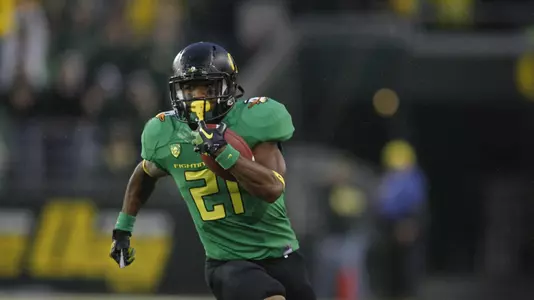
James' Hall of Fame Induction Becomes Official Tuesday
12/05/23 | Football, @GoDucksMoseley
The former UO running back will be honored Tuesday night during an awards dinner also to be attended by Campbell Trophy finalist Bo Nix.
LAS VEGAS — LaMichael James arrived at Oregon in 2008 having been raised by his extended family in a tough Texarkana neighborhood. Four years later, he had become the Ducks' all-time leading rusher, a Doak Walker Award winner, the first unanimous all-American in UO history and just the second Heisman Trophy finalist from Oregon.
His experience on the field with the Ducks prepared him for a four-year NFL career, and his experience in the classroom prepared him to become a successful business operator around the state. And on Tuesday evening, James' exploits earned him a spot on stage at the National Football Foundation's annual awards dinner, where he'll be recognized among the newest class of College Football Hall of Fame inductees.
Current UO quarterback Bo Nix also will attend the awards dinner, as a finalist for the William V. Campbell Trophy, which goes to college football's top scholar-athlete.
After redshirting in 2008, James was Oregon's lead back in 2009 and ran for 1,546 yards, at the time second in school history behind Jonathan Stewart's 1,722 yards in 2007. James broke that record in 2010 with 1,731 yards, earning unanimous all-American honors, a spot in New York as a Heisman finalist and the Doak Walker Award as the nation's top running back — at the time the most prestigious individual award won by a UO football player.
"LaMichael helped change college football," said Rob Mullens, who was named UO director of athletics the summer prior to James' sophomore season. "That's when we started to see an up-tempo offense that could compete at the highest level. And he was the perfect fit for that offense."

James then re-set Oregon's single-season rushing record in 2011, running for 1,805 yards to give him 5,082 in his three-year career — when no UO back had ever run for even 4,000 career yards at that point.
Since his time with the Ducks, James' single-season and career records have been surpassed, three others have been named unanimous all-American, and Marcus Mariota brought home the Heisman to Eugene. But on Tuesday, James receives an honor that can never be surpassed — inclusion with the rest of college football's all-time greats in the Hall of Fame.
"Of all the running backs that I've had the opportunity to call their games and watch them play," said Jerry Allen, radio voice of Oregon football, "he probably was the most electric — and for his size, powerful. He just had that 'it' factor that, if you needed a few yards or needed a guy to make a play for you, you just felt so confident he was going to be able to do it."
James was recruited to Oregon by long-time UO running backs coach Gary Campbell, who became one of the most important mentors in his life. On Monday, Campbell was in Las Vegas to attend a private dinner in James' honor, prior to the NFF ceremony Tuesday evening.
"He's undoubtedly the best running back that I coached at Oregon," Campbell said. "And the things that he's done are just remarkable. I'm so proud of him — he's like a son to me."

James grew up without knowing his father, and was raised primarily by his grandmother. After she passed away, he lived alone during his senior year of high school, keeping himself on track to get to Oregon and begin his collegiate career.
Once in Eugene, James was befriended by teammate Kenjon Barner, who would ultimately replace James as the UO starter in 2012, when James was an NFL rookie.
"His story is one that's prominent in our community as young black men," Barner said. "For him to be able to make it out of what he made it out from, make it away from everything he made it away from and turn his life into what he did, it speaks volumes to his determination, to his commitment to his craft."
After four years in the NFL, James moved into the business world, as a franchise owner with the Killer Burger chain. Earlier this year, he opened a restaurant in Eugene, the kid from Texarkana having grown into a thriving entrepreneur — with an historic college football career in between.
"A lot of people don't make it out of that," said Barner, who has visited James' hometown. "A lot of people can't break free of it. A lot of people have the opportunity but end up blowing it and losing the opportunity. But 'Mike' capitalized on it. Every step of the way he networked, he met the right people, he evolved and grew in the right ways. And that's why Mike is where he is today."
At Oregon, Barner had a front-row seat to watch James' development. Whispers out of Oregon's practices in 2008 suggested the Ducks had a talented running back on their hands, and fans got to see it first-hand in 2009. James ran for over 100 yards 10 times that season, helping the Ducks reach the Rose Bowl.

In 2010, he made his season debut at Tennessee and quickly supplied one of the biggest highlights of his career — a 72-yard touchdown run on which he was nearly tackled in the backfield, reversed course and outraced the Volunteers' defensive front to the sideline, broke another tackle deep down the field and dove across the end zone for the score.
When the play began, Oregon and Tennessee were tied, 13-13, early in the second half. The Ducks would go on to win 48-13.
"His desire, his will — Mike's a guy that won't be denied, no matter what it is," Barner said. "If he wants it, he's going to go get it."
"It was just explosive play after explosive play," Mullens said. "And a lot of them were runs between the tackles. He could turn what might have been a five-yard gain into a 35-yard gain in an instant, and just change the game."
James helped the Ducks go 12-0 and reach the national championship game in 2010. That year also saw him run for 257 yards and three touchdowns in a win over Stanford. His last touchdown was a 76-yard run, with Allen capping his call of the play as James scored with "Statement! Statement! Statement!" to mark Oregon's win in the battle of top-10 teams.
The next season, Allen was watching ESPN and saw a clip of his call included in a highlight montage.
"All of a sudden it was that play, and it was like, 'holy cow,'" Allen said. "That's respect for a running back. It was pretty special. … He had that magic about him, which you try to teach running backs. But some of them just have it. And he had it."

The 2011 season saw James break his own UO single-season rushing record, highlighted by 288 yards at Arizona. He ran for 219 yards and three touchdowns against UCLA in the inaugural Pac-12 Championship Game — his final performance at Autzen Stadium — before rushing for 159 yards in a Rose Bowl win over Wisconsin.
That fall saw James suffer an elbow dislocation at midseason. He missed only two games, and ran for 156 yards in a win at Washington less than a month later.
"Toughness," Allen said. "When he dislocated that elbow, then came back and played, that was huge."
After three seasons in the lineup and over 5,000 rushing yards, James opted to go pro. He had done more than enough to cement his legacy in the history of Oregon football. He remains beloved in the hearts of UO fans.
"He's a very understated person and an absolute team player, and people obviously gravitate to that," Mullens said. "So there was a lot to love, and our fans did love him."
Fans gravitated as well to James' personal story, and the hurdles he overcame to become an all-time great in Oregon football history. His desire and work ethic brought him all the way to the College Football Hall of Fame.
"One thing you can never measure about a man," Barner said, "is his heart. And Mike's heart is as big as they come."
His experience on the field with the Ducks prepared him for a four-year NFL career, and his experience in the classroom prepared him to become a successful business operator around the state. And on Tuesday evening, James' exploits earned him a spot on stage at the National Football Foundation's annual awards dinner, where he'll be recognized among the newest class of College Football Hall of Fame inductees.
Current UO quarterback Bo Nix also will attend the awards dinner, as a finalist for the William V. Campbell Trophy, which goes to college football's top scholar-athlete.
After redshirting in 2008, James was Oregon's lead back in 2009 and ran for 1,546 yards, at the time second in school history behind Jonathan Stewart's 1,722 yards in 2007. James broke that record in 2010 with 1,731 yards, earning unanimous all-American honors, a spot in New York as a Heisman finalist and the Doak Walker Award as the nation's top running back — at the time the most prestigious individual award won by a UO football player.
"LaMichael helped change college football," said Rob Mullens, who was named UO director of athletics the summer prior to James' sophomore season. "That's when we started to see an up-tempo offense that could compete at the highest level. And he was the perfect fit for that offense."
James then re-set Oregon's single-season rushing record in 2011, running for 1,805 yards to give him 5,082 in his three-year career — when no UO back had ever run for even 4,000 career yards at that point.
Since his time with the Ducks, James' single-season and career records have been surpassed, three others have been named unanimous all-American, and Marcus Mariota brought home the Heisman to Eugene. But on Tuesday, James receives an honor that can never be surpassed — inclusion with the rest of college football's all-time greats in the Hall of Fame.
"Of all the running backs that I've had the opportunity to call their games and watch them play," said Jerry Allen, radio voice of Oregon football, "he probably was the most electric — and for his size, powerful. He just had that 'it' factor that, if you needed a few yards or needed a guy to make a play for you, you just felt so confident he was going to be able to do it."
James was recruited to Oregon by long-time UO running backs coach Gary Campbell, who became one of the most important mentors in his life. On Monday, Campbell was in Las Vegas to attend a private dinner in James' honor, prior to the NFF ceremony Tuesday evening.
"He's undoubtedly the best running back that I coached at Oregon," Campbell said. "And the things that he's done are just remarkable. I'm so proud of him — he's like a son to me."
James grew up without knowing his father, and was raised primarily by his grandmother. After she passed away, he lived alone during his senior year of high school, keeping himself on track to get to Oregon and begin his collegiate career.
Once in Eugene, James was befriended by teammate Kenjon Barner, who would ultimately replace James as the UO starter in 2012, when James was an NFL rookie.
"His story is one that's prominent in our community as young black men," Barner said. "For him to be able to make it out of what he made it out from, make it away from everything he made it away from and turn his life into what he did, it speaks volumes to his determination, to his commitment to his craft."
After four years in the NFL, James moved into the business world, as a franchise owner with the Killer Burger chain. Earlier this year, he opened a restaurant in Eugene, the kid from Texarkana having grown into a thriving entrepreneur — with an historic college football career in between.
"A lot of people don't make it out of that," said Barner, who has visited James' hometown. "A lot of people can't break free of it. A lot of people have the opportunity but end up blowing it and losing the opportunity. But 'Mike' capitalized on it. Every step of the way he networked, he met the right people, he evolved and grew in the right ways. And that's why Mike is where he is today."
At Oregon, Barner had a front-row seat to watch James' development. Whispers out of Oregon's practices in 2008 suggested the Ducks had a talented running back on their hands, and fans got to see it first-hand in 2009. James ran for over 100 yards 10 times that season, helping the Ducks reach the Rose Bowl.
In 2010, he made his season debut at Tennessee and quickly supplied one of the biggest highlights of his career — a 72-yard touchdown run on which he was nearly tackled in the backfield, reversed course and outraced the Volunteers' defensive front to the sideline, broke another tackle deep down the field and dove across the end zone for the score.
When the play began, Oregon and Tennessee were tied, 13-13, early in the second half. The Ducks would go on to win 48-13.
"His desire, his will — Mike's a guy that won't be denied, no matter what it is," Barner said. "If he wants it, he's going to go get it."
"It was just explosive play after explosive play," Mullens said. "And a lot of them were runs between the tackles. He could turn what might have been a five-yard gain into a 35-yard gain in an instant, and just change the game."
James helped the Ducks go 12-0 and reach the national championship game in 2010. That year also saw him run for 257 yards and three touchdowns in a win over Stanford. His last touchdown was a 76-yard run, with Allen capping his call of the play as James scored with "Statement! Statement! Statement!" to mark Oregon's win in the battle of top-10 teams.
The next season, Allen was watching ESPN and saw a clip of his call included in a highlight montage.
"All of a sudden it was that play, and it was like, 'holy cow,'" Allen said. "That's respect for a running back. It was pretty special. … He had that magic about him, which you try to teach running backs. But some of them just have it. And he had it."
The 2011 season saw James break his own UO single-season rushing record, highlighted by 288 yards at Arizona. He ran for 219 yards and three touchdowns against UCLA in the inaugural Pac-12 Championship Game — his final performance at Autzen Stadium — before rushing for 159 yards in a Rose Bowl win over Wisconsin.
That fall saw James suffer an elbow dislocation at midseason. He missed only two games, and ran for 156 yards in a win at Washington less than a month later.
"Toughness," Allen said. "When he dislocated that elbow, then came back and played, that was huge."
After three seasons in the lineup and over 5,000 rushing yards, James opted to go pro. He had done more than enough to cement his legacy in the history of Oregon football. He remains beloved in the hearts of UO fans.
"He's a very understated person and an absolute team player, and people obviously gravitate to that," Mullens said. "So there was a lot to love, and our fans did love him."
Fans gravitated as well to James' personal story, and the hurdles he overcame to become an all-time great in Oregon football history. His desire and work ethic brought him all the way to the College Football Hall of Fame.
"One thing you can never measure about a man," Barner said, "is his heart. And Mike's heart is as big as they come."


Dierre Hill Jr. | Spring Practice #4
Thursday, April 02
Ra'Shaad Samples | Spring Practice #4
Thursday, April 02
Matayo Uiagalelei | Spring Practice #3
Tuesday, March 31
Iapani Laloulu | Spring Practice #3
Tuesday, March 31